 Tutorial Tutorial
|
| Topic |
|---|
| ShapeString (Draft workbench) |
| Level |
| Beginner |
| Time to complete |
| 30 minutes |
| Authors |
| r-frank |
| FreeCAD version |
| 0.16.6704 |
| Example files |
| Draft_Shapestring_Text |
| See also |
| None |
Introducere
În această lecţie vom discuta:
- insert a text with the
 ShapeString tool
 - extrude it to be a solid
- position it in 3D space using placement and Draft Move with sketches as helper elements
- doing an engraving by applying a boolean cut
This tutorial has been re-worked for FreeCAD v1.1, but it should be possible to follow the steps for v1.0 as well.
This tutorial describes a method to create 3D text and use it with solid objects in the  Part Workbench. We will discuss how to:
- insert outlined text with the
 Draft ShapeString tool,
 - position it on geometry using
 Part EditAttachment,
 - extrude it to be a 3D solid with
 Part Extrude, then finally
 - engrave the text by applying a boolean
 Part Cut.
To use ShapeStrings inside the  PartDesign Workbench, the process is essentially the same as with the Part Workbench, but the ShapeString must be placed inside the PartDesign Body. Go to the end of this tutorial for more information.
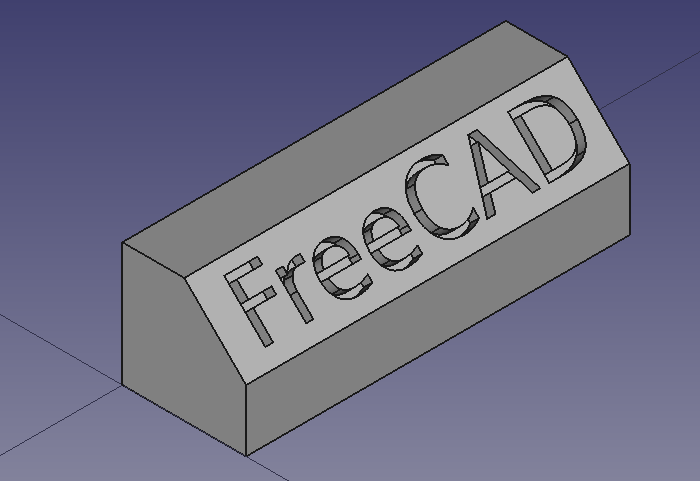
Final model of the engraved text.
Setup
1. Open FreeCAD and create a new empty document with File →  New Document.
- 1.1. Switch to the Part Workbench either with View → Workbench → Part Workbench, or with the Workbench Selector
 .
. - 1.2. Press the
 Isometric button, or press 0 in the numerical pad of your keyboard, to change the view to isometric to visualize the 3D solids better.
 - 1.3. Whenever you add objects, press the
 Fit All button, or its hotkey V, F. This will pan and zoom the 3D View so that all elements are visible in the view.
 - 1.4. Hold Ctrl while you click to select multiple items. If you make a wrong selected or want to de-select everything, just click in an empty area in the 3D View.
Crearea de forme de bază
- Start FreeCAD și creați un nou document
- Comutați la Atelierul Part/Piese
- Inserați un cub făcând click pe

- Make sure the cube is selected in the tree view
- Change width to be 31 mm by using the data-tab in the property view
- Click on
 to change to axometric view
 - Click on
 to zoom to fit all
 - Select upper edge on the front face of the cube in 3D view
- Apply a chamfer (to Edge6) of 5 mm by clicking on

- Make sure object "chamfer" is selected in the tree view and press <Space> to toggle visibility
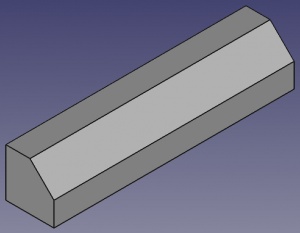
2. Create a rectangular box:
- 2.1. Insert a primitive cube by clicking on Cube.
- 2.2. Select the created
Cubein the Tree View. - 2.3. On the Data tab of the Property View:
- 2.3.1. Change Width to
31 mm.
- 2.3.1. Change Width to
- 2.4. Re-center the view per step 1.3.
3. Create a chamfer:
- 3.1. Select the upper edge (
Edge6) of the elongated face of theCubein the 3D View. - 3.2. Press
 Chamfer.
 - 3.3. In the Chamfer Edges task panel:
- 3.3.1. Verify that Select edges is selected and that the Chamfer type is
Equal distance. - 3.3.2. Change Length to
5 mm. - 3.3.3. Press OK. This will create a
Chamferobject.
- 3.3.1. Verify that Select edges is selected and that the Chamfer type is
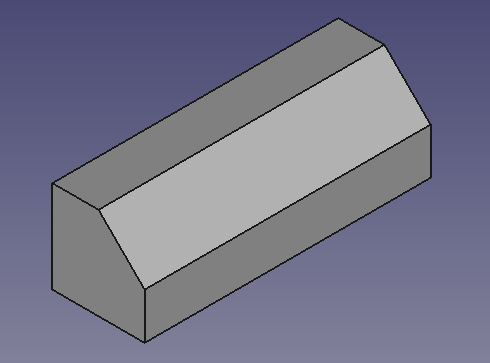
Base object created from an edited cube and a chamfer operation.
Inserarea de text cu instrumentul Draft ShapeString
- Switch to Draft workbench
- make sure nothing is selected in the tree view
- Toggle working plane to XY (Top) by clicking on
 Auto and choosing XY
 - Insert text "FreeCAD" by
- Click on

- Highlight the text in the "Global X"-field and type "0" on the keyboard and press Return
- Highlight the text in the "Global Y" field
- Type "0" on the keyboard and press Return
- Highlight the text in the "Global Z" field
- Type "0" on the keyboard and press Return
- Enter "FreeCAD" in the string field (without brackets) and press Return
- Choose a height of 5mm
- Choose a tracking of 0 mm
- now point FreeCAD to a "TTF"-Text-Font to use (for example the ARIAL-TTF)
- After pressing Return one last time, the Draft-Shapestring object is created in the tree view
- Click on
4. Create the ShapeString:
- 4.1. Switch to the Draft Workbench.
- 4.2. Click on Shape From Text.
- 4.3. In the ShapeString task panel:
- 4.3.1. Change Text to
FreeCAD. - 4.3.2. Change Height to
5 mm. - 4.3.3. Make sure Font file points to a valid font, (e.g,
/usr/share/fonts/truetype/dejavu/DejaVuSans.ttforC:/Windows/Fonts/arial.ttf).- Note: for more details about working with fonts please refer to the Draft ShapeString page.
- 4.3.4. Reset its location to the origin by pressing Reset Point.
- 4.3.5. Press OK. This will create a
ShapeStringobject.
- 4.3.1. Change Text to
- 4.4. In the Tree View, select
Chamfer. On the View tab, change the value of Visibility tofalse, or press Space on the keyboard. This will hide theChamferobject, so you can see theShapeStringbetter. - 4.5. To see the ShapeString from above change the view by pressing
 Top, or 2 on the keyboard.
 - 4.6. To restore the view to isometric, press Isometric, or 0 on the keyboard.
- 4.7. Reverse step 4.4 to make the
Chamferobject visible again.

Text created as a ShapeString, that is, a filled compound shape on a plane
5. Move the ShapeString to the Chamfer:
- 5.1. Make sure both the
Chamferobject and theShapeStringobject are visible in the 3D View. If one is not, select it in the Tree View and press Space on the keyboard. - 5.2. Switch to the Part Workbench.
- 5.3. In the Tree View, select
ShapeString. - 5.4. Select Part → Attachment.
- 5.5. In the 3D View, select the chamfered face of the
Chamfer. - 5.6. In the Attachment task panel:
- 5.6.1 Change the Attachment mode to
Inertia 2-3. - 5.6.2 Press OK.
- 5.6.1 Change the Attachment mode to
- 5.8. Make sure
Shapestringis selected in the Tree View. - 5.9. On the Data tab of the Property View:
- 5.9.1. Change Justification to
Middle-Center. - 5.9.2. Expand the Attachment Offset property node and change Angle to
90.0 °.
- 5.9.1. Change Justification to

The ShapeString centered on the chamfered face
Crearea de texte 3D
- Comutați pe Atelierul de Piese(Part workbench)
- Make sure the object "Shapestring" is selected in the tree view
- Use Part Extrude-Tool
 with the parameters:
- extrude Z=1 mm
- make sure to tick "create solid"
- use "OK" to finish part extrude operation
- Make sure object "Extrude" is selected in the tree view and press <Space> to toggle its visibility to be visible

6. Create a solid object from the ShapeString:
- 6.1. Make sure the Part Workbench is still active.
- 6.2. In the Tree View, select
ShapeString, then press Extrude. - 6.3. In the Extrude task panel:
- 6.3.1. In the Direction section select
Along normal - 6.3.2. In the Length section set Along to
0 mmand Against to1 mm. - 6.3.3. Check the Create solid option.
- 6.3.4. Press OK. This will create an
Extrudeobject.
- 6.3.1. In the Direction section select
- 6.4. Since it has been extruded into the
Chamferobject, the 3D View will look the same as before. Verify the creation of a solid 3D object by temporarily making theChamferobject invisible:- 6.4.1. In Tree View, select
Chamfer. - 6.4.2. Press Space to hide it. You should see a solid 3D object in the shape of the word "FreeCAD".
- 6.4.3. Press Space to make the Chamfer visible again.
- 6.4.1. In Tree View, select

The 3D text after making the Chamfer object invisible.
7. Engrave the text on the geometry:
Final model: a chamfered cube, with engraved text created from ShapeString, Extrude, and boolean Cut operations.
Engraving 3D text with the PartDesign Workbench
A similar process as described above can be done with the PartDesign Workbench.
- Create the Draft ShapeString first.
- Create a
 PartDesign Body, make it active, and create a base solid by adding a primitive, or by extruding a sketch with
  PartDesign Pad.
 - Move the
ShapeStringobject into the active body. - Attach the
ShapeStringobject to one of the faces of the solid, or to an edge of the sketch, using Part EditAttachment. - Now create a PartDesign Pad or a
 PartDesign Pocket from the
 ShapeString, in order to produce an additive or a subtractive feature respectively.
See the forum thread How to use ShapeStrings in PartDesign.
Notă
- To create curved text you can use
 Macro FCCircularText.
 - To import text from an SVG file look at the Import text and geometry from Inkscape tutorial.
Această pagină este preluată de la https://wiki.freecad.org/Draft_ShapeString_tutorial