|
|
| Description |
|---|
| This macro automatically creates aliases in a two-dimensional table using the names of the rows and columns. A second function can create a link between a cell and a property value in an object. |
| Author |
| 2cv001 |
| Download |
| Links |
| Macros recipes How to install macros How to customize toolbars |
| Macro Version |
| beta |
| Date last modified |
| 2024-02-22 |
| FreeCAD Version(s) |
| All |
| Default shortcut |
| None |
| See also |
| None |

Description
This macro automatically creates aliases in a two-dimensional table using the names of the rows and columns. A second function can create a link between a cell and a property value of an object. To be able to use this function, you just have to place the name of the relevant object in the column and the name of the property in the row.
The syntax for the alias created by the macro is: LabelObject_Property.

The macro can also automatically fill property values of objects (such as body, sketch, etc.) based on these aliases.
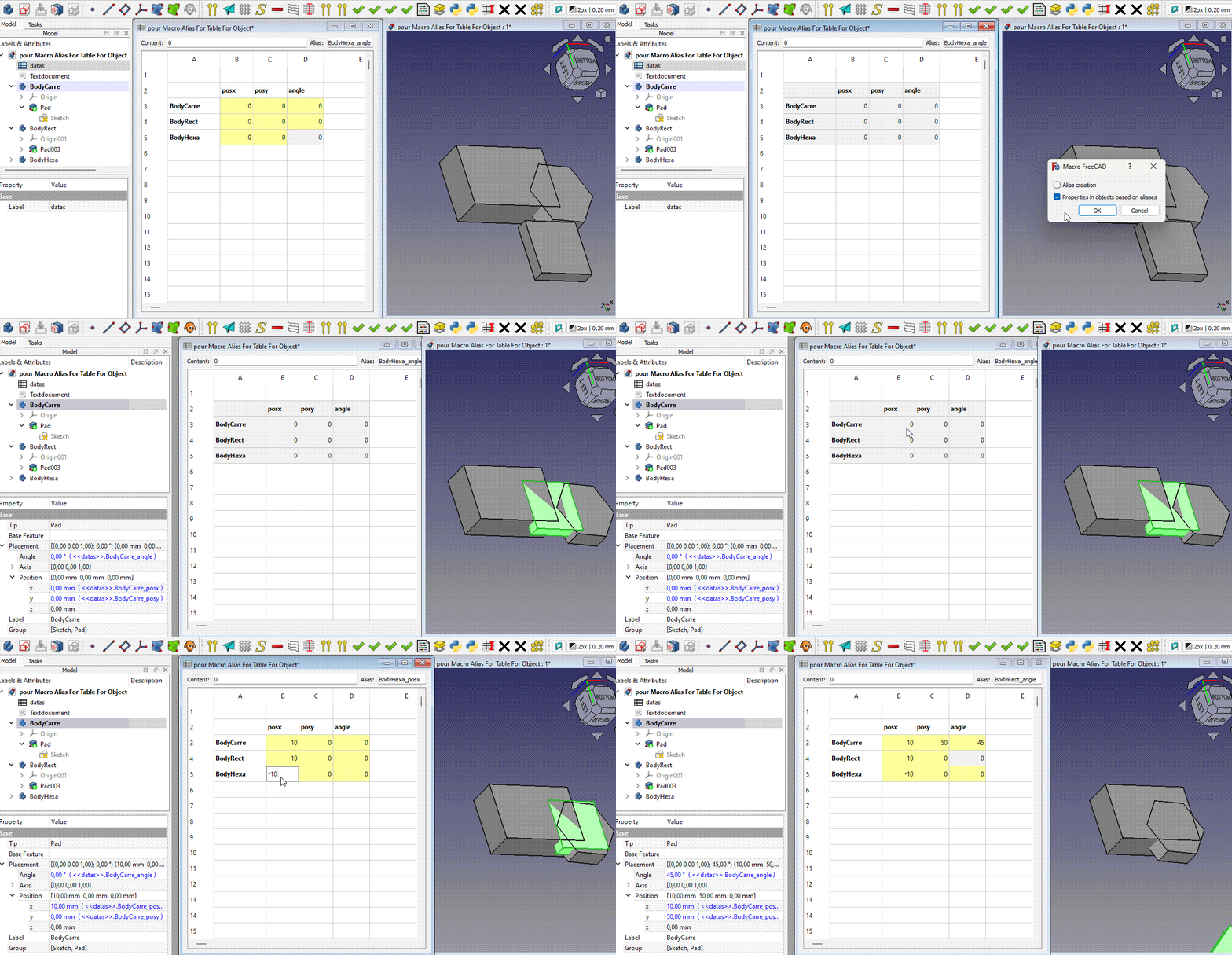
Usage
Automatic alias creation
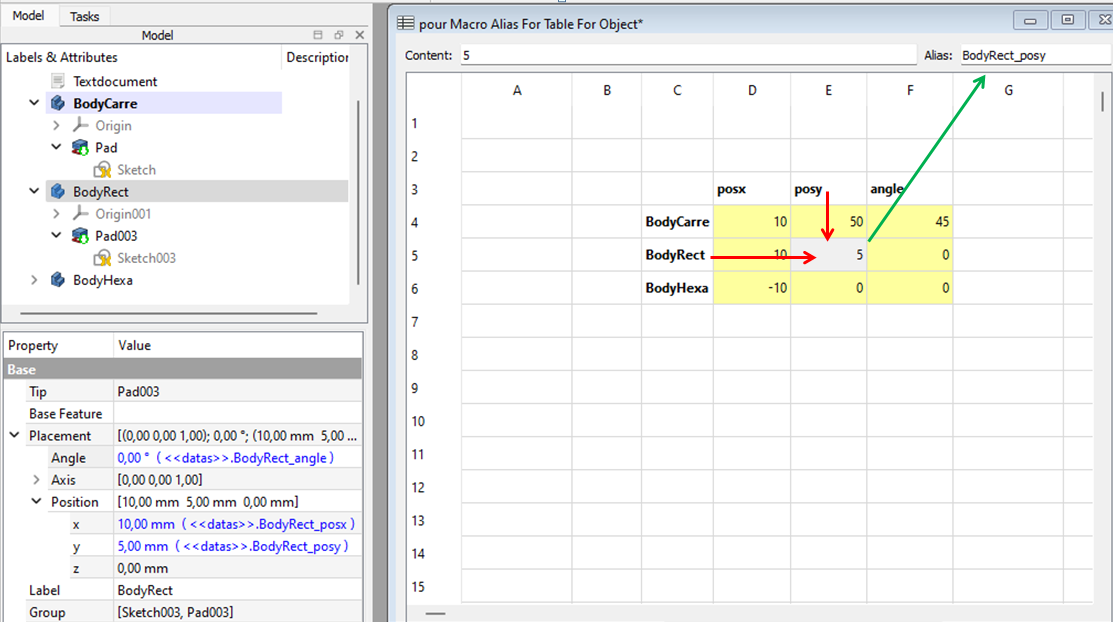
Fill a spreadsheet with a column containing object labels (Body, sketch, Pad, ...) and a row corresponding to properties. In the code you will find the correspondence between the properties and what to put in this row. See dico= below.
For example, use posy for property Placement.Base.y.
Select the cells in the table with the object labels column and properties row, and then run the Macro and check the first option:
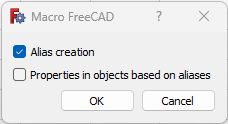
The macro will create aliases with this syntax: LabelObject_Property. For instance: BodyRect_posy.
Part of the dico (check the code of the macro for the full dico):
dico={
        "posx" : "Placement.Base.x",
        "posy" : "Placement.Base.y",
        "posz" : "Placement.Base.z",
        "posX" : "Placement.Base.x",
        "posY" : "Placement.Base.y",
        "posZ" : "Placement.Base.z",
        "angle": "Placement.Rotation.Angle",
        "ang"  : "Placement.Rotation.Angle",
        "axisx": "Placement.Rotation.Axis.x",
        "axisy": "Placement.Rotation.Axis.y",
        "axisz": "Placement.Rotation.Axis.z",
        "axeX" : "Placement.Rotation.Axis.x",
        "axeY" : "Placement.Rotation.Axis.y",
        "axeZ" : "Placement.Rotation.Axis.z",
        "attachementX" : "AttachmentOffset.Base.x",
        "attachementY" : "AttachmentOffset.Base.y",
        "attachementZ" : "AttachmentOffset.Base.z",
        "attachementAngle" : "AttachmentOffset.Rotation.Angle",
        "attachementAxisX" : "AttachmentOffset.Rotation.Axis.x",
        "attachementAxisY" : "AttachmentOffset.Rotation.Axis.y",
        "attachementAxisZ" : "AttachmentOffset.Rotation.Axis.z",
        "Length" : "Length",
        "Length2": "Length2",
        "Radius" : "Radius",
        "Height" : "Height",
        "FirstAngle" : "FirstAngle",
        "SecondAngle": "SecondAngle",
        "Angle1" : "Angle1",
        "Angle2" : "Angle2",
        "Angle3" : "Angle3",
Automatic values in properties
Select some cells in the table with values and aliases created previously. Run the macro and select the second option (Both options can be selected at the same time to chain them together.)

The macro will assign values to the properties via an expression referencing the alias of the cells. From now on, if you change a value in the table, the property value will change and everything will be recalculated.

Examples
Pad

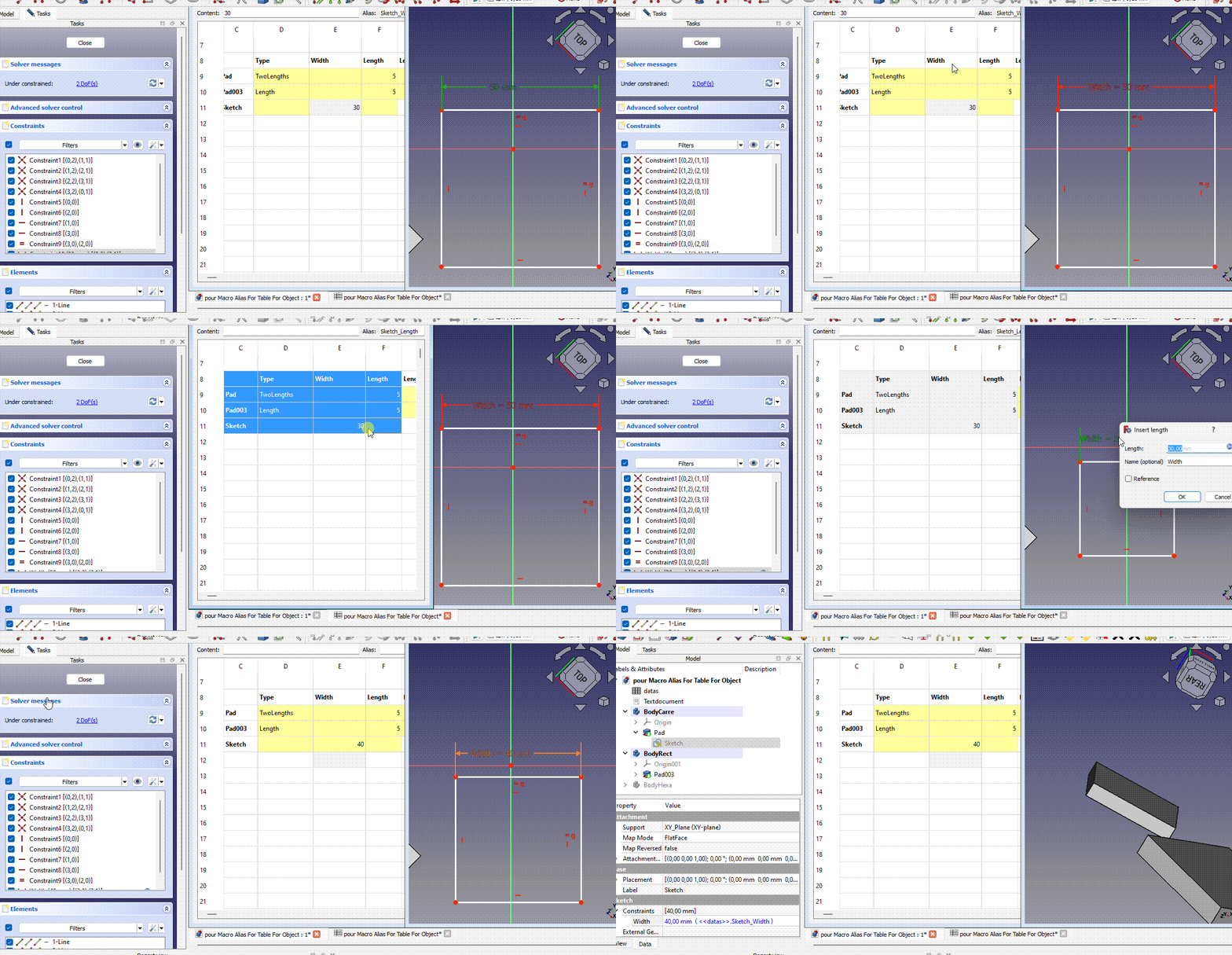
Sketch constraints
Give a name to the constraint (here: Width) (Pay attention to the case.) Add a column with this constraint name in the properties row, and add a row with the label of the Sketch (here: Sketch). Run the macro.
Credits
This macro was developed based on an idea suggested by Esprit. Also, many thanks to him for the numerous ideas and tests he has carried out.
Version information
ver 25/02/2024 by 2cv001 Alias_For_Table_For_Object.FCMacro
Code

#!/usr/bin/env python
# -*- coding: utf-8 -*-
# ========================================================================
# Macro Alias for table for object
# file name : Alias_For_Table_For_Object.FCMacro
# ========================================================================


__Name__   = "Alias for table for object"
__Comment__ ="Automatically creates aliases in a two-dimensional table using the names of the rows and columns"
__Author__ = "2cv001"
__Title__   = "Alias For Table For Object"
__Date__    = "2024/02/20"    #YYYY/MM/DD 14;21 Béta
__Version__ = __Date__
__License__ = "Apache-2.0"
__Wiki__ = "https://wiki.freecad.org/Macro_Alias_For_Table_For_Object"
# https://forum.freecad.org/viewtopic.php?t=84878
#===========================================================================================
# The macro automatically creates alias in a two-dimensional table using the name of the row
# and the name of the column. To be able to use the "Table to object" function
# put the name of the concerned object in the column and the name of the property in the row.
# the alias creation function will create alias (except dico, see below)
# with this syntax  "LabelObject_property"
#
# The macro can also automatically fill the properties of objects (body, sketch, ...) based on
# aliases created by 'Create alias for table' and which indicate the object and the property
#
# The dico (see further in the code) is used to convert what you put in the top line to match
# what needs to be put in the expression. For example, if you have "posx" in the
# first line of your selection, in the expression, for the property part, there will be
# "Placement.Base.x"
#==========================================================================================


import FreeCAD, FreeCADGui
import re
from PySide import QtGui, QtCore, QtWidgets

addNumberIfOther=True

class CheckBoxDialog(QtWidgets.QDialog):
    def __init__(self, parent=None):
        super(CheckBoxDialog, self).__init__(parent)

        self.setWindowTitle("Macro FreeCAD")

        self.createAliasForTableCheckBox = QtWidgets.QCheckBox("Alias creation")
        self.createAliasForTableCheckBox.setToolTip("Creates an alias in each selected cell" +
                "\nbased on the first selected row and column" +
                "\nThe aliases will be in the format 'LabelObject_property'")
        self.tableToObjectCheckBox = QtWidgets.QCheckBox("Properties in objects based on aliases")
        self.tableToObjectCheckBox.setToolTip("Automatically fills the properties of objects (body, sketch, ...)" +
                "\nbased on aliases which must be in the format 'LabelObject_property'")
        buttonBox = QtWidgets.QDialogButtonBox(QtWidgets.QDialogButtonBox.Ok | QtWidgets.QDialogButtonBox.Cancel)
        buttonBox.accepted.connect(self.accept)
        buttonBox.rejected.connect(self.reject)

        layout = QtWidgets.QVBoxLayout()
        layout.addWidget(self.createAliasForTableCheckBox)
        layout.addWidget(self.tableToObjectCheckBox)
        layout.addWidget(buttonBox)
        self.setLayout(layout)

    def accept(self):
        super(CheckBoxDialog, self).accept()


def get_column(cell):
    column = ''.join([c for c in cell if not c.isdigit()])
    return column

def get_row(cell):
    row = ''.join([c for c in cell if c.isdigit()])
    if row=='' :
        row='1'
    return int(row)


#################################################################################
# part code for alias
#################################################################################
# parameters for alias creation
separateur = " "      # typically put " " so blanks will be replaced by nouveauCaract
nouveauCaract = ''    #Put for example "_" to have the separators replaced by "_". Put "" to have no separator
majuscule = True      #set to True if you want  "Diametre du cercle" to be "DiametreDuCercle"
changeTexteCellule = False  # the text will only be changed if changeCellText is True.
                          # This does not change anything for the allias itself
premierCaractereEnMinuscule = False # Force the first character to be in lower case

# list of characters to be replaced by an equivalent. for example an @ will be replaced by 'a'
# if you add characters, please send me a private message. Il will eventually add it in my code.
caracEquivalents = [ ['é','e'],['è','e'],['ê','e'],['à','a'],['@','a'],['&','e'],['ç','c'],
                  ['²','2'],["'",''],['?',''],['"',''],['(',''],[')',''],['#',''],['.',''],
                  [',',''],[';',''],['$',''],['+',''],['-',''],['*',''],['/',''],['\\',''] ,
                  ['[',''],[']',''],
                  ]


def traitementChaineSource(chaineSource, separateur, nouveauCaract, majuscule):
# If separator is ' ' and nouveauCaract is '_', and majuscule is True
# transforms "Diametre du cylindre" into "Diametre_Du_Cylindre

    def remplaceCararcDansMot(mot):

        def remplaceCartatParEquivalent(caractere):
        # replaces a character with its equivalent if it exists
            caracResult = caractere
            for couple in caracEquivalents:
                if (couple[0] == caractere):
                    caracResult = couple[1]
                    break
            return caracResult

    #replaces all characters of the word with its equivalent if it exists
        motResult = mot
        for caract in mot:
            a = remplaceCartatParEquivalent(caract)
            motResult = motResult.replace(caract, a)
        return motResult


    chaineResult = ''
    first = True
    carctDeSeparation = ''
    for mots in chaineSource.split(separateur):
        mots = remplaceCararcDansMot(mots)
        if (not (first)):
            carctDeSeparation = nouveauCaract
            if (majuscule):
                chaineResult = chaineResult + nouveauCaract + mots[:1].upper() + mots[1:]
                # We use "[:1]" instead of "[0]",
                # for no crash in case of an empty string (which happens if the cell is empty)
        else:
            chaineResult = chaineResult + nouveauCaract + mots
        first=False
    if premierCaractereEnMinuscule :
        chaineResult = chaineResult[:1].lower() + chaineResult[1:]
    return chaineResult


def create_alias_for_table_cells_Selected():
    mySpreadsheet = Gui.ActiveDocument.ActiveView.getSheet()
    aw = Gui.getMainWindow().centralWidget().activeSubWindow() # Store the active window
    # To get list of all selected cells
    sel_items = aw.widget().findChild(QtGui.QTableView).selectedIndexes()

    getCellName = lambda r,c:'{}{}{}'.format(chr(c//26 + 64) if c//26 > 0 else '', chr(c%26 + 65), r + 1)


    for item in sel_items: # The selected cells are scanned

        if  (sel_items[0].column()!=item.column() and sel_items[0].row()!=item.row()) :
            cellName=getCellName(item.row(), item.column())
            firstcellName=getCellName(sel_items[0].row(), sel_items[0].column())

            cellTextLine=get_column(firstcellName)+str(get_row(cellName))
            cellTextColumn=get_column(cellName)+ str(get_row(firstcellName))
            try :
                textLine = mySpreadsheet.get(cellTextLine)
                textColumn = mySpreadsheet.get(cellTextColumn)

            except :
                #print('Des cellules en première colonne ou en première ligne ne sont pas conformes')
                continue
            textAlias =  str(textLine) + '_'  + str(textColumn)
            textAlias=traitementChaineSource(textAlias, separateur, nouveauCaract, majuscule)
            if addNumberIfOther :
                startIndexForTextAlias=1
                for i in range(startIndexForTextAlias, 201):
                    try:
                        if i == 1:
                            mySpreadsheet.setAlias(cellName, textAlias)
                        else:
                            mySpreadsheet.setAlias(cellName, textAlias + '_' + str(i-1))
                            startIndexForTextAlias=i+1
                        break  # Arrête la boucle si aucune exception n'est levée
                    except:
                        continue  # Passe à l'itération suivante si une exception est levée


# The dictionary is used to convert what you put in the top line to match
# what needs to be put in the expression. For example, if you have “posx” in the
# first line of your selection, in the expression, for the property part, there will be
# "Placement.Base.x"
dico={
        "posx" : "Placement.Base.x",
        "posy" : "Placement.Base.y",
        "posz" : "Placement.Base.z",
        "posX" : "Placement.Base.x",
        "posY" : "Placement.Base.y",
        "posZ" : "Placement.Base.z",
        "angle": "Placement.Rotation.Angle",
        "ang": "Placement.Rotation.Angle",
        "axisx": "Placement.Rotation.Axis.x",
        "axisy": "Placement.Rotation.Axis.y",
        "axisz": "Placement.Rotation.Axis.z",
        "axeX": "Placement.Rotation.Axis.x",
        "axeY": "Placement.Rotation.Axis.y",
        "axeZ": "Placement.Rotation.Axis.z",
        "attachementX" : "AttachmentOffset.Base.x",
        "attachementY" : "AttachmentOffset.Base.y",
        "attachementZ" : "AttachmentOffset.Base.z",
        "attachementAngle" : "AttachmentOffset.Rotation.Angle",
        "attachementAxisX" : "AttachmentOffset.Rotation.Axis.x",
        "attachementAxisY" : "AttachmentOffset.Rotation.Axis.y",
        "attachementAxisZ" : "AttachmentOffset.Rotation.Axis.z",
        "Length" : "Length",
        "Length2" : "Length2",
        "Radius" : "Radius",
        "Height" : "Height",
        "FirstAngle" : "FirstAngle",
        "SecondAngle" : "SecondAngle",
        "Angle1" : "Angle1",
        "Angle2" : "Angle2",
        "Angle3" : "Angle3",
     }


def set_constraint_expression(sketchLabel, constraint_name, expression):
    # Get all Sketches with this label
    findConstraint = False
    sketches = App.ActiveDocument.getObjectsByLabel(sketchLabel)
    if len(sketches) > 1 :
        print("Warning, multiple sketches have the same label. "
              " All these sketches will be processed. "
              "This may cause problems if different sketches with the same label "
              "have constraints with the same name.")
    # Go through all Sketches

    for sketch in sketches:

        # Go through all constraints in the Sketch
        for i in range(sketch.ConstraintCount):
            # Get the constraint
            constraint = sketch.Constraints[i]

            # Check if the constraint name matches the one we're looking for
            if constraint.Name == constraint_name:
                # Modify the constraint value
                sketch.setExpression(f'Constraints[{i}]', expression)
                findConstraint=True
                break
    return findConstraint


def set_property_based_on_alias(sheet,cell):

    # alias of the cell
    alias = sheet.getAlias(cell)
    # Check if the alias is valid
    if sheet.getContents(cell)!='' :
        if alias is None:
            print(f"The selected cell {cell} does not have an alias.")
            return

    # Separate the alias into body name and property name
    # ex 'body_Name_posX' -> body_Name for the object and posX for property name
    parts = alias.rsplit('_', 1)
    if len(parts) != 2:
        print("The alias must be in the form 'BodyName_PropertyName'.")
        return

    objLabel, property_name = parts
    try :
        obj=App.ActiveDocument.getObjectsByLabel(objLabel)[0]
    except :
        print('no object with this label : ',objLabel)
        return
    try :
        property_name=dico[property_name]
    except :
        try :
            if  obj.TypeId != 'Sketcher::SketchObject' :
                print (f'property {property_name} not found in the dictionary. See at the top of the source code')
        except :
            pass


    if obj is None:
        print(f"There is no object named '{objLabel}' in the document.")
        return

    # Create an expression that refers to the cell's alias
    expression = f"<<{sheet.Label}>>.{alias}"

    # Modify the object's property
    # if it's a constraint
    if  obj.TypeId == 'Sketcher::SketchObject' :
        findConstraint=set_constraint_expression(objLabel, property_name, expression)
        if findConstraint : # if not we continue to find a property
            return

    if hasattr(obj, property_name.split('.')[0]): # Placement.Base.x -> Placement
        obj.setExpression(property_name, expression)
    else:
        print(f"The object '{objLabel}' does not have a property '{property_name}'.")


def tableToObject() :
    sheet = Gui.ActiveDocument.ActiveView.getSheet()
    # Check if the spreadsheet is active
    if sheet.TypeId != 'Spreadsheet::Sheet':
        print("Please select cells in a spreadsheet.")
        return

    # active cell
    #cell = Gui.activeView().currentIndex()

    aw = Gui.getMainWindow().centralWidget().activeSubWindow() # Store the active window
    # To get list of all selected cells
    sel_items = aw.widget().findChild(QtGui.QTableView).selectedIndexes()
    getCellName = lambda r,c:'{}{}{}'.format(chr(c//26 + 64) if c//26 > 0 else '', chr(c%26 + 65), r + 1)
    for cell in sel_items: # The selected cells are scanned
        cellName=getCellName(cell.row(), cell.column())

        if str(sheet.getContents(cellName))!= '' :
            set_property_based_on_alias(sheet, cellName)


def main():
    dialog = CheckBoxDialog()
    result = dialog.exec_()
    if result and dialog.createAliasForTableCheckBox.isChecked() :
        create_alias_for_table_cells_Selected()
    if result and dialog.tableToObjectCheckBox.isChecked() :
        tableToObject()
    return result


if __name__ == '__main__':
    main()
Ta strona pochodzi z https://wiki.freecad.org/Macro_Alias_For_Table_For_Object