


|
|
| Ubicación en el Menú |
|---|
| Dibujo → Herramientas Bézier → Cubic Curva Bézier |
| Entornos de trabajo |
| Borrador, Arquitectura |
| Atajo de teclado por defecto |
| Ninguno |
| Introducido en versión |
| 0.19 |
| Ver también |
| Borrador BezCurva, Borrador BSpline |
Descripción
El comando  Borrador CubicBezCurva crea una Curva de Bézier de tercer grado (se requieren cuatro puntos).
La Curva de Bézier es una de las curvas más utilizadas en infografía. Este comando permite crear una spline continua formada por varios segmentos de Bézier de tercer grado, de forma similar a la herramienta Bézier de Inkscape. Una curva Bézier general de cualquier grado puede ser creada con el comando Borrador BezCurva.
Los comandos Borrador de BezCurva y Borrador de CubicBezCurve utilizan puntos de control para definir la posición y la curvatura de la spline. El comando Borrador BSpline, en cambio, especifica los puntos exactos por los que pasará la curva.
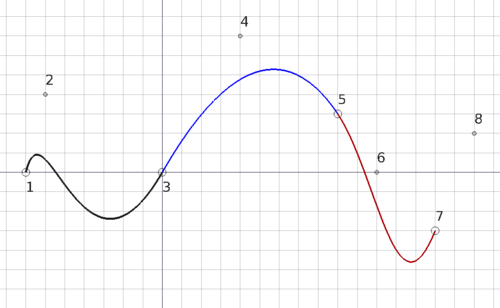
Spline formada por tres segmentos cúbicos de Bézier. El primer segmento está definido por cuatro puntos. Los segmentos posteriores reutilizan dos puntos del segmento anterior y, por tanto, sólo requieren dos puntos adicionales.
Utilización
Ver también: Bandeja de borrador, Borrador Snap y Borrador Constreñido.
- There are several ways to invoke the command:
- Press the Cubic Bézier Curve button.
- Draft: Select the Drafting → Bézier Tools → Cubic Bézier Curve option from the menu.
- BIM: Select the 2D Drafting → Cubic Bézier Curve option from the menu.
- Press the
- The Cubic Bézier Curve task panel opens. See Options for more information.
- It is not possible the enter points via the task panel.
- For the following Mouse Navigation Models a keyboard key must to be held down:
- If you are using OpenInventor Navigation the Ctrl key must be held down throughout the command.
- If you are using Gesture Navigation the Alt key must be held down for each click-hold-release sequence, but is also possible to keep this key held down throughout the command.
- Pick the first point in the 3D View and hold the mouse button (1), this is the first endpoint.
- Drag the pointer to another point in the 3D View and release the mouse button (2), this is the first control point.
- Move the pointer to another point in the 3D View, pick this point and hold the mouse button (3), this is the second endpoint.
- Move the pointer to another point in the 3D View to adjust the final curvature of the segment and release the mouse button (4), this is the second control point.
- You now have one Bézier curve of the 3rd degree.
- Optionally repeat the process of clicking and holding (5), and dragging and releasing (6) to add more segments.
- Each subsequent segment will use the second endpoint and second control point of the previous segment as its first endpoint and first control point respectively.
- Press Esc or the Close button to finish the command.
Opciones
See Draft BezCurve.
Notas
- A Draft CubicBezCurve can be edited with the Draft Edit command.
Propiedades
See Draft BezCurve.
Archivos de guión
See also: Autogenerated API documentation and FreeCAD Scripting Basics.
See Draft BezCurve for general information. A cubic Bézier is created by passing the option degree=3 to makeBezCurve().
For each cubic Bézier segment four points must be used, of which the two extreme points indicate where the spline passes through, and the two intermediate points are control points.
- If only 3 points are given, it creates a quadratic Bézier instead, with only one control point.
- If only 2 points are given, it creates a linear Bézier, that is, a straight line.
- If 5 points are given, the first 4 create a cubic Bézier segment; the 4th and the 5th points are used to create a straight line.
- If 6 points are given, the first 4 create a cubic Bézier segment; the 4th and the other two points are used to create a quadratic Bézier segment.
- If 7 points are given, the first 4 create a cubic Bézier segment; the 4th and the other three points are used to create a second cubic Bézier segment.
- In general, the last point in a group of four is shared with the following three points maximum to create another Bézier segment.
- To have smooth curves, with no straight segments, the number of points should be
3n + 1or3n, wherenis the number of segments, forn >= 1.
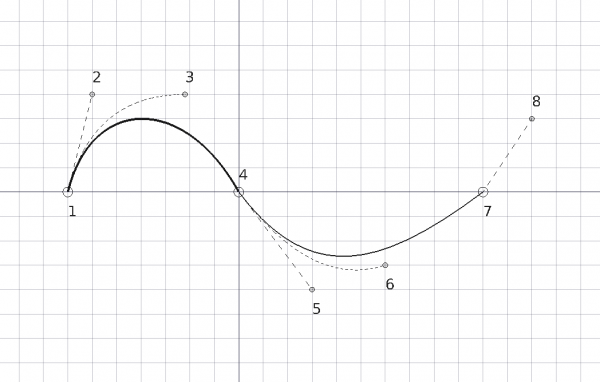
Ejemplos de curvas de Bézier producidas utilizando 2, 3, 4, 5, 6, 7 y 8 puntos. Las líneas sólidas indican segmentos cúbicos de Bézier; las otras líneas son cuadráticas o lineales.
Ejemplo:
import FreeCAD as App
import Draft

doc = App.newDocument()

p1 = App.Vector(-3500, 0, 0)
p2 = App.Vector(-3000, 2000, 0)
p3 = App.Vector(-1100, 2000, 0)
p4 = App.Vector(0, 0, 0)

p5 = App.Vector(1500, -2000, 0)
p6 = App.Vector(3000, -1500, 0)
p7 = App.Vector(5000, 0, 0)
p8 = App.Vector(6000, 1500, 0)
rot = App.Rotation()

c1 = Draft.make_circle(100, placement=App.Placement(p1, rot), face=False)
c1.Label = "B1_E1"
c2 = Draft.make_circle(50, placement=App.Placement(p2, rot), face=True)
c2.Label = "B1_c1"
c3 = Draft.make_circle(50, placement=App.Placement(p3, rot), face=True)
c3.Label = "B1_c2"
c4 = Draft.make_circle(100, placement=App.Placement(p4, rot), face=False)
c4.Label = "B1_E2"
c5 = Draft.make_circle(50, placement=App.Placement(p5, rot), face=True)
c5.Label = "B2_c3"
c6 = Draft.make_circle(50, placement=App.Placement(p6, rot), face=True)
c6.Label = "B2_c4"
c7 = Draft.make_circle(100, placement=App.Placement(p7, rot), face=False)
c7.Label = "B2_E3"
c8 = Draft.make_circle(50, placement=App.Placement(p8, rot), face=True)
c8.Label = "B3_c5"

doc.recompute()

B1 = Draft.make_bezcurve([p1, p2], degree=3)
B1.Label = "B_lin"
B1.ViewObject.DrawStyle = "Dashed"

B2 = Draft.make_bezcurve([p1, p2, p3], degree=3)
B2.Label = "B_quad"
B2.ViewObject.DrawStyle = "Dotted"

B3 = Draft.make_bezcurve([p1, p2, p3, p4], degree=3)
B3.Label = "B_cub"
B3.ViewObject.LineWidth = 4

B4 = Draft.make_bezcurve([p1, p2, p3, p4, p5], degree=3)
B4.Label = "B_cub+lin"
B4.ViewObject.DrawStyle = "Dashed"

B5 = Draft.make_bezcurve([p1, p2, p3, p4, p5, p6], degree=3)
B5.Label = "B_cub+quad"
B5.ViewObject.DrawStyle = "Dotted"

B6 = Draft.make_bezcurve([p1, p2, p3, p4, p5, p6, p7], degree=3)
B6.Label = "B_cub+cub"
B6.ViewObject.LineWidth = 2

B7 = Draft.make_bezcurve([p1, p2, p3, p4, p5, p6, p7, p8], degree=3)
B7.Label = "B_cub+cub+lin"
B7.ViewObject.DrawStyle = "Dashed"

doc.recompute()
Esta página ha sido recuperada de https://wiki.freecad.org/Draft_CubicBezCurve