|
|
| Description |
|---|
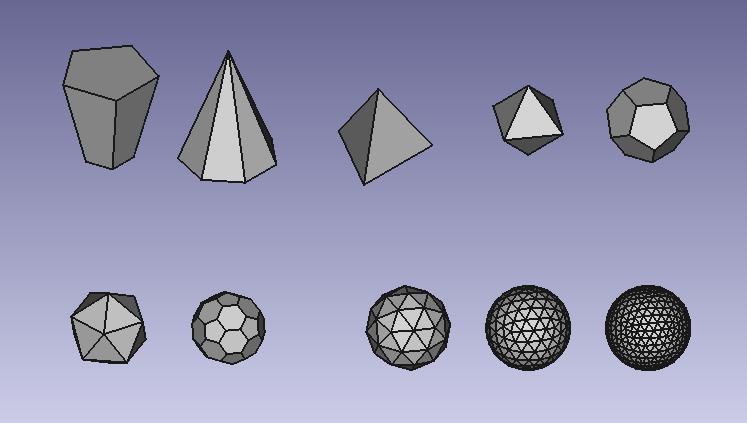
| This macro creates parametric polyhedrons: tetrahedron, hexahedron, octahedron, dodecahedron, icosahedron, icosahedron_truncated Parameters radius and side can be adjusted. Macro version: 01.05 Last modified: 2025-11-15 FreeCAD version: All Download: ToolBar Icon Author: Eddy Verlinden, Genk, Belgium |
| Author |
| Eddy Verlinden, Genk, Belgium |
| Download |
| ToolBar Icon |
| Links |
| Macros recipes How to install macros How to customize toolbars |
| Macro Version |
| 01.05 |
| Date last modified |
| 2025-11-15 |
| FreeCAD Version(s) |
| All |
| Default shortcut |
| None |
| See also |
| Macro Pyramid |
Description
This macro creates parametric polyhedrons: tetrahedron, hexahedron, octahedron, dodecahedron, icosahedron, icosahedron_truncated, and geodesic spheres at several levels
Notes
- If you're also interested in pyramids, then you can use
 Pyramid macro.
 - You can also make use of the the external workbench Pyramids_and_Polyhedrons that contains the same functions.
Installation
- Use the
 Addon Manager to install the macro via Tools → Addon Manager → Macros tab
 - Choose
polyhedrons.py - Press Install
Usage
- Once installed, open Macro → Macros.
- Click on
polyhedrons.pyand then click on the Execute button. - In a popup you can select the type of polyhedron, and you can set the size of the radius or the length of the sides.
- Press OK
Note: You can always adjust the radius or the size, just like with normal parts.
- More info at Pyramids_and_Polyhedrons.
Related
The forum discussion Macros for pyramids and polyhedrons
Script
ToolBar Icon 
polyhedrons.py
# ***************************************************************************
# * Copyright (c) 2019 Eddy Verlinden , Genk Belgium (eddyverl) *
# * *
# * This file is part of the FreeCAD CAx development system. *
# * *
# * This program is free software; you can redistribute it and/or modify *
# * it under the terms of the GNU Lesser General Public License (LGPL) *
# * as published by the Free Software Foundation; either version 2 of *
# * the License, or (at your option) any later version. *
# * for detail see the LICENCE text file. *
# * *
# * FreeCAD is distributed in the hope that it will be useful, *
# * but WITHOUT ANY WARRANTY; without even the implied warranty of *
# * MERCHANTABILITY or FITNESS FOR A PARTICULAR PURPOSE. See the *
# * GNU Lesser General Public License for more details. *
# * *
# * You should have received a copy of the GNU Library General Public *
# * License along with FreeCAD; if not, write to the Free Software *
# * Foundation, Inc., 59 Temple Place, Suite 330, Boston, MA 02111-1307 *
# * USA *
# * *
# ***************************************************************************
__Title__ = "Macro_Polyhedrons"
__Author__ = "Eddy Verlinden"
__Version__ = "01.05"
__Date__ = "2025-11-15"
__Comment__ = "This macro creates parametric polyhedrons."
# version 1.05 (2025-11-15)
# follow Qt5 namespacing
# added flag for local styling - original style choices not great dark themes
# no functional changes
# version 1.04 (2020-02-25)
# correction : value of the side of icosahedron-truncated
# ver 01.03 (2020-01-15) :
# => added geodesic spheres
# => some additions to the dialog
# ver 01.02 (2020-01-10)
# => first release
import math
import sys, time
from PySide import QtGui, QtCore, QtWidgets
import FreeCAD, FreeCADGui
from FreeCAD import Base
import Part
LOCAL_STYLE = False
def horizontal_regular_polygon_vertexes(sidescount, radius, z, startangle=0):
vertexes = []
if radius != 0 :
for i in range(0,sidescount+1):
angle = 2 * math.pi * i / sidescount + math.pi + startangle
vertex = (radius * math.cos(angle), radius * math.sin(angle), z)
vertexes.append(vertex)
else:
vertex = (0,0,z)
vertexes.append(vertex)
return vertexes
# ===========================================================================
class Tetrahedron:
# == basics ==
#R = z / 4 * sqrt(6)
#ro = z / 12 * sqrt(6) --> ro = R / 3
#z = 4 * R / sqrt(6)
#h = z / 3 * sqrt(6) = 4 * R / sqrt(6) /3 * sqrt(6) = 4 * R / 3 = ro + R
#radius at level = z / 2 / cos(30) = (4 * R / sqrt(6)) / 2 / sqrt(3) * 2 = 4 * R / (sqrt(6) * sqrt(3))= 4 * R / (3 * sqrt(2)
radiusvalue = 0
def __init__(self, obj, radius=5):
obj.addProperty("App::PropertyLength","Radius","Tetrahedron","Radius of the tetrahedron").Radius = radius
obj.addProperty("App::PropertyLength","Side","Tetrahedron","Sidelength of the tetrahedron")
obj.Proxy = self
def execute (self,obj):
radius = float(obj.Radius)
if (radius != self.radiusvalue):
obj.Side = radius * 4 / math.sqrt(6)
self.radiusvalue = radius
else:
self.radiusvalue = float(obj.Side * math.sqrt(6) / 4)
obj.Radius = self.radiusvalue
radius = self.radiusvalue
faces = []
vertexes_bottom = horizontal_regular_polygon_vertexes(3, 4 * radius / 3 / math.sqrt(2), - radius / 3)
vertexes_top = horizontal_regular_polygon_vertexes(1, 0, radius)
for i in range(3):
vertexes_side = [vertexes_bottom[i], vertexes_bottom[i+1], vertexes_top[0], vertexes_bottom[i]]
polygon_side = Part.makePolygon(vertexes_side)
faces.append(Part.Face(polygon_side))
polygon_bottom = Part.makePolygon(vertexes_bottom)
faces.append(Part.Face(polygon_bottom))
shell = Part.makeShell(faces)
solid = Part.makeSolid(shell)
obj.Shape = solid
# ===========================================================================
class Hexahedron:
radiusvalue = 0
def __init__(self, obj, radius=5):
obj.addProperty("App::PropertyLength","Radius","Hexahedron","Radius of the hexahedron").Radius = radius
obj.addProperty("App::PropertyLength","Side","Hexahedron","Sidelength of the hexahedron")
obj.Proxy = self
def execute(self, obj):
radius = float(obj.Radius)
if (radius != self.radiusvalue):
side = radius * 2 / math.sqrt(3)
obj.Side = side
self.radiusvalue = radius
else:
self.radiusvalue = obj.Side / 2 * math.sqrt(3)
obj.Radius = self.radiusvalue
radius = self.radiusvalue
side = obj.Side
faces = []
vertexes_bottom = horizontal_regular_polygon_vertexes(4, math.sqrt(side ** 2 / 2), -side/2, math.pi/4)
vertexes_top = horizontal_regular_polygon_vertexes(4, math.sqrt(side ** 2 / 2), side/2, math.pi/4)
for i in range(4):
vertexes_side = [vertexes_bottom[i], vertexes_bottom[i+1], vertexes_top[i+1], vertexes_top[i], vertexes_bottom[i]]
polygon_side = Part.makePolygon(vertexes_side)
faces.append(Part.Face(polygon_side))
polygon_bottom = Part.makePolygon(vertexes_bottom)
faces.append(Part.Face(polygon_bottom))
polygon_top = Part.makePolygon(vertexes_top)
faces.append(Part.Face(polygon_top))
shell = Part.makeShell(faces)
solid = Part.makeSolid(shell)
obj.Shape = solid
# ===========================================================================
class Octahedron:
# Z = R * sqrt(2)
radiusvalue = 0
def __init__(self, obj, radius=5):
obj.addProperty("App::PropertyLength","Radius","Octahedron","Radius of the octahedron").Radius = radius
obj.addProperty("App::PropertyLength","Side","Octahedron","Sidelength of the octahedron")
obj.Proxy = self
def execute (self,obj):
radius = float(obj.Radius)
if (radius != self.radiusvalue):
obj.Side = radius * math.sqrt(2)
self.radiusvalue = radius
else:
self.radiusvalue = float(obj.Side / math.sqrt(2))
obj.Radius = self.radiusvalue
radius = self.radiusvalue
faces = []
vertexes_middle = horizontal_regular_polygon_vertexes(4, radius, 0)
vertexes_bottom = horizontal_regular_polygon_vertexes(1, 0,-radius)
vertexes_top = horizontal_regular_polygon_vertexes(1, 0, radius)
for i in range(4):
vertexes_side = [vertexes_middle[i], vertexes_middle[i+1], vertexes_top[0], vertexes_middle[i]]
polygon_side = Part.makePolygon(vertexes_side)
faces.append(Part.Face(polygon_side))
for i in range(4):
vertexes_side = [vertexes_middle[i], vertexes_middle[i+1], vertexes_bottom[0], vertexes_middle[i]]
polygon_side = Part.makePolygon(vertexes_side)
faces.append(Part.Face(polygon_side))
shell = Part.makeShell(faces)
solid = Part.makeSolid(shell)
obj.Shape = solid
# ===========================================================================
class Dodecahedron:
radiusvalue = 0
def __init__(self, obj, radius=5):
obj.addProperty("App::PropertyLength","Radius","Dodecahedron","Radius of the dodecahedron").Radius = radius
obj.addProperty("App::PropertyLength","Side","Dodecahedron","Sidelength of the dodecahedron")
obj.Proxy = self
def execute (self,obj):
angleribs = 121.717474411
anglefaces = 116.565051177
radius = float(obj.Radius)
if (radius != self.radiusvalue):
obj.Side = 4 * radius / (math.sqrt(3) * ( 1 + math.sqrt(5)))
self.radiusvalue = radius
else:
self.radiusvalue = float(obj.Side * (math.sqrt(3) * ( 1 + math.sqrt(5))) / 4)
obj.Radius = self.radiusvalue
radius = self.radiusvalue
faces = []
z = 4 * radius / (math.sqrt(3) * ( 1 + math.sqrt(5)))
r = z/2 * math.sqrt((25 + (11 * math.sqrt(5)))/10)
# int sphere r is height / 2
h2 = z * math.sin(angleribs/180 * math.pi)
# height of the side-tips
radius1 = z / 2 / math.sin(36 * math.pi / 180)
h5h = (radius1 + radius1 * math.cos(36 * math.pi / 180)) * math.sin(anglefaces * math.pi / 180) #height of the tops
radius2 = radius1 - z * math.cos(angleribs * math.pi / 180 )
r = (h2 + h5h) / 2 # XXX to make it fit!
vertexes_bottom = horizontal_regular_polygon_vertexes(5, radius1, -r)
vertexes_low = horizontal_regular_polygon_vertexes(5, radius2, -r + h2)
vertexes_high = horizontal_regular_polygon_vertexes(5, radius2, -r + h5h, math.pi/5)
vertexes_top = horizontal_regular_polygon_vertexes(5, radius1, r, math.pi/5)
polygon_bottom = Part.makePolygon(vertexes_bottom)
face_bottom = Part.Face(polygon_bottom)
faces.append(face_bottom)
polygon_top = Part.makePolygon(vertexes_top)
face_top = Part.Face(polygon_top)
faces.append(face_top)
for i in range(5):
vertexes_side = [vertexes_bottom[i],vertexes_bottom[i+1],vertexes_low[i+1],vertexes_high[i],vertexes_low[i], vertexes_bottom[i]]
polygon_side = Part.makePolygon(vertexes_side)
faces.append(Part.Face(polygon_side))
for i in range(5):
#vertexes_side=[vertexes_top[i],vertexes_top[i+1],vertexes_high[i+1],vertexes_high2[i], vertexes_high[i],vertexes_top[i] ]
vertexes_side = [vertexes_top[i], vertexes_top[i+1], vertexes_high[i+1], vertexes_low[i+1], vertexes_high[i], vertexes_top[i]]
polygon_side = Part.makePolygon(vertexes_side)
faces.append(Part.Face(polygon_side))
shell = Part.makeShell(faces)
solid = Part.makeSolid(shell)
obj.Shape = solid
# ===========================================================================
class Icosahedron:
radiusvalue = 0
def __init__(self, obj, radius=5):
obj.addProperty("App::PropertyLength","Radius","Icosahedron","Radius of the icosahedron").Radius = radius
obj.addProperty("App::PropertyLength","Side","Icosahedron","Sidelength of the icosahedron")
obj.Proxy = self
def execute (self,obj):
radius = float(obj.Radius)
if (radius != self.radiusvalue):
obj.Side = 4 * radius / math.sqrt(10 + 2 * math.sqrt(5))
self.radiusvalue = radius
else:
self.radiusvalue = float(obj.Side * math.sqrt(10 + 2 * math.sqrt(5)) / 4)
obj.Radius = self.radiusvalue
radius = self.radiusvalue
z = 4 * radius / math.sqrt(10 + 2 * math.sqrt(5))
anglefaces = 138.189685104
r = z/12 * math.sqrt(3) * (3 + math.sqrt(5))
# radius of a pentagon with the same side
radius2 = z / math.sin(36 * math.pi/180) / 2
# height of radius2 in the sphere
angle = math.acos(radius2/radius)
height = radius * math.sin(angle)
faces = []
vertex_bottom = (0,0,-radius)
vertexes_low = horizontal_regular_polygon_vertexes(5, radius2, -height)
vertexes_high = horizontal_regular_polygon_vertexes(5, radius2, height, math.pi/5)
vertex_top = (0, 0, radius)
for i in range(5):
vertexes_side = [vertex_bottom,vertexes_low[i], vertexes_low[i+1], vertex_bottom]
polygon_side = Part.makePolygon(vertexes_side)
faces.append(Part.Face(polygon_side))
for i in range(5):
vertexes_side = [vertexes_low[i], vertexes_low[i+1], vertexes_high[i], vertexes_low[i]]
polygon_side = Part.makePolygon(vertexes_side)
faces.append(Part.Face(polygon_side))
vertexes_side = [vertexes_high[i], vertexes_high[i+1], vertexes_low[i+1], vertexes_high[i]]
polygon_side = Part.makePolygon(vertexes_side)
faces.append(Part.Face(polygon_side))
for i in range(5):
vertexes_side = [vertex_top,vertexes_high[i], vertexes_high[i+1], vertex_top]
polygon_side = Part.makePolygon(vertexes_side)
faces.append(Part.Face(polygon_side))
shell = Part.makeShell(faces)
solid = Part.makeSolid(shell)
obj.Shape = solid
# ===========================================================================
class Icosahedron_truncated:
radiusvalue = 0
def __init__(self, obj, radius=5):
obj.addProperty("App::PropertyLength","Radius","Icosahedron_truncated","Radius (of the base-icosahedron)").Radius = radius
obj.addProperty("App::PropertyLength","Side","Icosahedron_truncated","Sidelength of the truncated icosahedron")
obj.Proxy = self
def execute (self,obj):
radius = float(obj.Radius)
if (radius != self.radiusvalue):
obj.Side = 4 * radius / math.sqrt(10 + 2 * math.sqrt(5)) / 3
self.radiusvalue = radius
else:
self.radiusvalue = float(obj.Side * math.sqrt(10 + 2 * math.sqrt(5)) / 4) * 3
obj.Radius = self.radiusvalue
radius = self.radiusvalue
z = 4*radius / math.sqrt(10 + 2 * math.sqrt(5))
anglefaces = 138.189685104
r = z/12 * math.sqrt(3) * (3 + math.sqrt(5))
# radius of a pentagon with the same side
radius2 = z / math.sin(36 * math.pi/180) / 2
# height of radius2 in the sphere
angle = math.acos(radius2/radius)
height = radius * math.sin(angle)
faces = []
vertex_bottom = (0, 0, -radius)
vertexes_low = horizontal_regular_polygon_vertexes(5, radius2, -height)
vertexes_high = horizontal_regular_polygon_vertexes(5, radius2, height, -math.pi/5)
vertex_top = (0, 0, radius)
vertexes_bottom = []
vertexes_top = []
for i in range(6):
new_vertex = ((vertex_bottom[0]+vertexes_low[i][0])/3 , (vertex_bottom[1]+vertexes_low[i][1])/3 , vertex_bottom[2]-(vertex_bottom[2]-vertexes_low[i][2])/3)
vertexes_bottom.append(new_vertex)
polygon_side = Part.makePolygon(vertexes_bottom)
faces.append(Part.Face(polygon_side))
for i in range(6):
new_vertex = ((vertex_top[0]+vertexes_high[i][0])/3 , (vertex_top[1]+vertexes_high[i][1])/3 , vertex_top[2]-(vertex_top[2]-vertexes_high[i][2])/3)
vertexes_top.append(new_vertex)
polygon_side = Part.makePolygon(vertexes_top)
faces.append(Part.Face(polygon_side))
pg6_bottom = []
for i in range(5):
vertex1 = vertexes_bottom[i]
vertex2 = vertexes_bottom[i+1]
vertex3 = (vertexes_bottom[i+1][0] + (vertexes_low[i+1][0] - vertexes_bottom[i+1][0])/2, vertexes_bottom[i+1][1] + (vertexes_low[i+1][1] - vertexes_bottom[i+1][1])/2, (vertexes_low[i+1][2] + vertexes_bottom[i+1][2])/2)
vertex4 = ((vertexes_low[i+1][0]*2 + vertexes_low[i][0])/3, (vertexes_low[i+1][1]*2 + vertexes_low[i][1])/3, -height)
vertex5 =((vertexes_low[i+1][0] + vertexes_low[i][0]*2)/3, (vertexes_low[i+1][1] + vertexes_low[i][1]*2)/3, -height)
vertex6 = (vertexes_bottom[i][0] + (vertexes_low[i][0] - vertexes_bottom[i][0])/2, vertexes_bottom[i][1] + (vertexes_low[i][1] - vertexes_bottom[i][1])/2, (vertexes_low[i][2] + vertexes_bottom[i][2])/2)
vertexes = [vertex1, vertex2, vertex3, vertex4, vertex5, vertex6, vertex1]
pg6_bottom.append(vertexes)
polygon_side = Part.makePolygon(vertexes)
faces.append(Part.Face(polygon_side))
pg6_top = []
for i in range(5):
vertex1 = vertexes_top[i]
vertex2 = vertexes_top[i+1]
vertex3 = (vertexes_top[i+1][0] + (vertexes_high[i+1][0] - vertexes_top[i+1][0])/2, vertexes_top[i+1][1] + (vertexes_high[i+1][1] - vertexes_top[i+1][1])/2, (vertexes_high[i+1][2] + vertexes_top[i+1][2])/2)
vertex4=((vertexes_high[i+1][0]*2 +vertexes_high[i][0])/3, (vertexes_high[i+1][1]*2 +vertexes_high[i][1])/3, height)
vertex5 = ((vertexes_high[i+1][0]+vertexes_high[i][0]*2)/3, (vertexes_high[i+1][1] +vertexes_high[i][1]*2)/3, height)
vertex6 = (vertexes_top[i][0] + (vertexes_high[i][0] - vertexes_top[i][0])/2, vertexes_top[i][1] + (vertexes_high[i][1] - vertexes_top[i][1])/2, (vertexes_high[i][2] + vertexes_top[i][2])/2)
vertexes = [vertex1, vertex2, vertex3, vertex4, vertex5, vertex6, vertex1]
pg6_top.append(vertexes)
polygon_side = Part.makePolygon(vertexes)
faces.append(Part.Face(polygon_side))
pg6_low = []
for i in range(5):
vertex1 = pg6_bottom[i][3]
vertex2 = pg6_bottom[i][4]
vertex3 = ((vertexes_low[i][0]*2 + vertexes_high[i+1][0])/3,(vertexes_low[i][1]*2 + vertexes_high[i+1][1])/3, (vertexes_low[i][2]*2 + vertexes_high[i+1][2])/3)
vertex4 = ((vertexes_low[i][0] + vertexes_high[i+1][0]*2)/3,(vertexes_low[i][1] + vertexes_high[i+1][1]*2)/3, (vertexes_low[i][2] + vertexes_high[i+1][2]*2)/3)
vertex5 = ((vertexes_low[i+1][0] + vertexes_high[i+1][0]*2)/3,(vertexes_low[i+1][1] + vertexes_high[i+1][1]*2)/3, (vertexes_low[i+1][2] + vertexes_high[i+1][2]*2)/3)
vertex6 = ((vertexes_low[i+1][0]*2 + vertexes_high[i+1][0])/3,(vertexes_low[i+1][1]*2 + vertexes_high[i+1][1])/3, (vertexes_low[i+1][2]*2 + vertexes_high[i+1][2])/3)
vertexes = [vertex1, vertex2, vertex3, vertex4, vertex5, vertex6, vertex1]
pg6_low.append(vertexes)
polygon_side = Part.makePolygon(vertexes)
faces.append(Part.Face(polygon_side))
pg6_high = []
for i in range(5):
vertex1 = pg6_top[i][3]
vertex2 = pg6_top[i][4]
vertex3 = pg6_low[i-1][4]
vertex4 = pg6_low[i-1][5]
vertex5 = pg6_low[i][2]
vertex6 = pg6_low[i][3]
vertexes = [vertex1, vertex2, vertex3, vertex4, vertex5, vertex6, vertex1]
pg6_high.append(vertexes)
polygon_side = Part.makePolygon(vertexes)
faces.append(Part.Face(polygon_side))
for i in range(5):
vertex1 = pg6_top[i][4]
vertex2 = pg6_top[i][5]
vertex3 = pg6_high[i-1][6]
vertex4 = pg6_high[i-1][5]
vertex5 = pg6_low[i-1][4]
vertexes = [vertex1, vertex2, vertex3, vertex4, vertex5, vertex1]
polygon_side = Part.makePolygon(vertexes)
faces.append(Part.Face(polygon_side))
for i in range(5):
vertex1 = pg6_bottom[i][4]
vertex2 = pg6_bottom[i][5]
vertex3 = pg6_low[i-1][6]
vertex4 = pg6_low[i-1][5]
vertex5 = pg6_high[i][4]
vertexes = [vertex1, vertex2, vertex3, vertex4, vertex5, vertex1]
polygon_side = Part.makePolygon(vertexes)
faces.append(Part.Face(polygon_side))
shell = Part.makeShell(faces)
solid = Part.makeSolid(shell)
obj.Shape = solid
# ===========================================================================
def geodesic_radius2side(radius, div):
# approximative experience values! Not all sides are equal!
dictsides = {"2": 618.034, "3": 412.41, "4": 312.87, "5": 245.09, "6": 205.91,
"7": 173.53, "8": 152.96, "9": 135.96, "10":121.55}
div = int(round(div))
if div < 0:
return 0
if div == 1:
return radius * 4 / math.sqrt(10 + 2 * math.sqrt(5))
elif div <= 10:
factor = dictsides[str(div)]
return radius * factor / 1000
def geodesic_side2radius(side, div):
# approximative experience values! Not all sides are equal!
dictsides = {"2": 618.034, "3": 412.41, "4": 312.87, "5": 245.09, "6": 205.91,
"7": 173.53, "8": 152.96, "9": 135.96, "10": 121.55}
div = int(round(div))
if div < 0:
return 0
if div == 1:
return side / 4 * math.sqrt(10 + 2 * math.sqrt(5))
elif div <= 10:
factor = dictsides[str(div)]
return side * 1000 / factor
# ===========================================================================
class Geodesic_sphere:
radiusvalue = 0
divided_by = 2
def __init__(self, obj, radius=5, div=2):
obj.addProperty("App::PropertyLength","Radius","Geodesic","Radius of the sphere").Radius = radius
obj.addProperty("App::PropertyLength","Side","Geodesic","Sidelength of the triangles (approximative!)")
obj.addProperty("App::PropertyInteger","DividedBy","Geodesic","The sides of the icosahedron are divided in x").DividedBy = div
obj.Proxy = self
def geodesic_divide_triangles(self, vertex1, vertex2, vertex3, faces):
vector1 = (Base.Vector(vertex2) - Base.Vector(vertex1)) / self.divided_by
vector2 = (Base.Vector(vertex3) - Base.Vector(vertex2)) / self.divided_by
icosaPt={}
icosaPt[str(1)] = Base.Vector(vertex1)
for level in range(self.divided_by):
l1 = level + 1
icosaPt[str(l1*10+1)] = icosaPt[str(1)]+ vector1 * (l1)
for pt in range(level+1):
icosaPt[str(l1*10+2+pt)] = icosaPt[str(l1*10+1)] + vector2 *(pt+1)
for level in range(self.divided_by):
for point in range(level+1):
vertex1x = icosaPt[str(level*10+1+point)].normalize().multiply(self.radiusvalue)
vertex2x = icosaPt[str(level*10+11+point)].normalize().multiply(self.radiusvalue)
vertex3x = icosaPt[str(level*10+12+point)].normalize().multiply(self.radiusvalue)
polygon = Part.makePolygon([vertex1x, vertex2x, vertex3x, vertex1x])
faces.append(Part.Face(polygon))
for point in range(level):
vertex1x = icosaPt[str(level*10+1+point)].normalize().multiply(self.radiusvalue)
vertex2x = icosaPt[str(level*10+2+point)].normalize().multiply(self.radiusvalue)
vertex3x = icosaPt[str(level*10+12+point)].normalize().multiply(self.radiusvalue)
polygon = Part.makePolygon([vertex1x,vertex2x,vertex3x, vertex1x])
faces.append(Part.Face(polygon))
return faces
def execute (self,obj):
obj.DividedBy = int(round(obj.DividedBy))
if obj.DividedBy <= 0:
obj.DividedBy = 1
radius = float(obj.Radius)
if radius != self.radiusvalue or obj.DividedBy != self.divided_by:
self.divided_by = obj.DividedBy
obj.Side = geodesic_radius2side(radius, self.divided_by)
self.radiusvalue = radius
else:
self.radiusvalue = geodesic_side2radius(obj.Side,self.divided_by)
obj.Radius = self.radiusvalue
radius = self.radiusvalue
self.divided_by = obj.DividedBy
z = 4 * radius / math.sqrt(10 + 2 * math.sqrt(5))
anglefaces = 138.189685104
r = z/12 * math.sqrt(3) * (3 + math.sqrt(5))
# radius of a pentagram with the same side
radius2 = z / math.sin(36 * math.pi/180) / 2
# height of radius2 in the sphere
angle = math.acos(radius2 / radius)
height = radius * math.sin(angle)
faces = []
vertex_bottom = (0 ,0, -radius)
vertexes_low = horizontal_regular_polygon_vertexes(5, radius2, -height)
vertexes_high = horizontal_regular_polygon_vertexes(5, radius2, height, math.pi/5)
vertex_top = (0, 0, radius)
for i in range(5):
faces = self.geodesic_divide_triangles(vertex_bottom, vertexes_low[i+1], vertexes_low[i], faces)
for i in range(5):
faces = self.geodesic_divide_triangles(vertexes_high[i], vertexes_low[i+1], vertexes_low[i], faces)
faces = self.geodesic_divide_triangles(vertexes_low[i+1], vertexes_high[i+1], vertexes_high[i], faces)
for i in range(5):
faces = self.geodesic_divide_triangles(vertex_top, vertexes_high[i], vertexes_high[i+1], faces)
shell = Part.makeShell(faces)
solid = Part.makeSolid(shell)
obj.Shape = solid
# ===========================================================================
class ViewProviderBox:
obj_name = "polyhedron"
def __init__(self, obj, obj_name):
self.obj_name = obj_name
obj.Proxy = self
def attach(self, obj):
return
def updateData(self, fp, prop):
return
def getDisplayModes(self, obj):
return "As Is"
def getDefaultDisplayMode(self):
return "As Is"
def setDisplayMode(self, mode):
return "As Is"
def onChanged(self, vobj, prop):
pass
def getIcon(self):
return """
/* XPM */
static char * xpm[] = {
"32 32 9 1",
" c None",
". c #010050",
"+ c #000641",
"@ c #04036A",
"# c #00019A",
"$ c #272687",
"% c #3E3EA2",
"& c #4C4BBF",
"* c #6466FC",
" ",
" ",
" ",
" @###@$% ",
" @#####@&**& ",
" @#####@&******% ",
" @#####@%*********% ",
" @###@@$%***********& ",
" +@@$****%************* ",
" &********&************& ",
" *********%************$+ ",
" *********&************+. ",
" %**********%***********+.+ ",
" &**********%**********%..+ ",
" &***********&*********+.. ",
" &***********%&********+.. ",
" ***********&@#@@$$%&&*+.. ",
" ***********@#########+..+ ",
" **********$##########...+ ",
" +********%###########...+ ",
" ++$*****&############...+ ",
" +..+&***@############... ",
" +..++*$#############..+ ",
" +...+@#############.. ",
" +...+@############.+ ",
" ...+@##########@ ",
" +..+@#######@ ",
" +..+@####@ ",
" ++++.@. ",
" ",
" ",
" "};
"""
def __getstate__(self):
return None
def __setstate__(self, state):
return None
# ===========================================================================
def msgbox(s):
msg = QtWidgets.QMessageBox()
msg.setIcon(QtWidgets.QMessageBox.Information)
msg.setText(s)
msg.setWindowTitle("Message")
msg.setStandardButtons(QtWidgets.QMessageBox.Ok )
retval = msg.exec_()
# ===========================================================================
class polyhedron_dialog(QtWidgets.QWidget):
polyhedronname = ""
def __init__(self):
super(polyhedron_dialog, self).__init__()
self.initUI()
def initUI(self):
grid = QtWidgets.QGridLayout()
button = QtWidgets.QPushButton('Cancel')
if LOCAL_STYLE:
button.setStyleSheet("color:blue")
grid.addWidget(button, 10, 3)
button.clicked.connect(self.cancel_method)
button2 = QtWidgets.QPushButton('OK')
if LOCAL_STYLE:
button2.setStyleSheet("color:blue")
grid.addWidget(button2, 10, 5)
button2.clicked.connect(self.slot_method)
self.listBox = QtWidgets.QListWidget(self)
grid.addWidget(self.listBox, 0, 3)
self.listBox.addItem("tetrahedron")
self.listBox.addItem("hexahedron")
self.listBox.addItem("octahedron")
self.listBox.addItem("dodecahedron")
self.listBox.addItem("icosahedron")
self.listBox.addItem("icosahedron-truncated")
self.listBox.addItem("geodesic-sphere")
self.listBox.itemClicked.connect(self.listwidgetclicked)
grid.addWidget(QtWidgets.QLabel('radius :'), 3, 2)
self.radius = QtWidgets.QLineEdit("5")
if LOCAL_STYLE:
self.radius.setStyleSheet("background : white; font-weight:bold; padding-left:10px")
grid.addWidget(self.radius, 3, 3)
grid.addWidget(QtWidgets.QLabel('or sidelength:'), 3, 4)
self.side = QtWidgets.QLineEdit()
if LOCAL_STYLE:
self.side.setStyleSheet("background : white; font-weight:bold; padding-left:10px")
grid.addWidget(self.side, 3, 5)
self.warning = QtWidgets.QLineEdit()
self.warning.setStyleSheet("color : red")
grid.addWidget(self.warning, 5, 3)
self.setLayout(grid)
self.move(500, 350)
self.setWindowTitle('Polyhedrons as FreeCad-Part')
self.show()
def listwidgetclicked(self, item):
self.polyhedronname = format(item.text())
self.warning.clear()
def slot_method(self):
if self.listBox.selectedItems() == []:
self.warning.setText("Select a type!")
return
if (str(self.radius.text()))== "":
radius = 0
else:
radius = float(str(self.radius.text()))
if (str(self.side.text()))== "":
side = 0
else:
side = float(str(self.side.text()))
if radius == 0 and side == 0 :
self.warning.setText("INPUT ERROR! No radius nor side!")
return
if radius != 0 and side != 0 :
self.warning.setText("INPUT ERROR! Only One value allowed!")
return
else :
if FreeCAD.ActiveDocument == None:
FreeCAD.newDocument()
obj = FreeCAD.ActiveDocument.addObject("Part::FeaturePython", self.listBox.currentItem().text())
if self.listBox.currentItem().text() == "tetrahedron":
if radius==0:
radius = side / 4 * math.sqrt(6)
Tetrahedron(obj, radius)
elif self.listBox.currentItem().text() == "hexahedron":
if radius == 0:
radius = side * 2 / math.sqrt(3)
Hexahedron(obj, radius)
elif self.listBox.currentItem().text() == "octahedron":
if radius == 0:
radius = side / math.sqrt(2)
Octahedron(obj, radius)
elif self.listBox.currentItem().text() == "dodecahedron":
if radius == 0:
radius = side / 4 * math.sqrt(3) * (1 + math.sqrt(5))
Dodecahedron(obj, radius)
elif self.listBox.currentItem().text() == "icosahedron":
if radius == 0:
radius = side / 4 * math.sqrt(10 + 2 * math.sqrt(5))
Icosahedron(obj, radius)
elif self.listBox.currentItem().text() == "icosahedron-truncated":
if radius == 0:
radius = side / 4 * math.sqrt(10 + 2 * math.sqrt(5)) * 3
Icosahedron_truncated(obj,radius)
elif self.listBox.currentItem().text() == "geodesic-sphere":
if radius == 0:
radius = side / 2 * math.sqrt(10 + 2 * math.sqrt(5))
Geodesic_sphere(obj,radius)
obj.ViewObject.Proxy = 0
ViewProviderBox(obj.ViewObject, self.listBox.item)
FreeCAD.ActiveDocument.recompute()
FreeCADGui.SendMsgToActiveView("ViewFit")
self.close()
def cancel_method(self):
self.close()
mainaction = polyhedron_dialog()
Ta strona pochodzi z https://wiki.freecad.org/Macro_Polyhedrons